From as far back as I remember, I have always been surrounded by different voices. Influenced by traditional Chinese concepts, my family believes that family members should remain together. Growing up in a big family with multiple generations means language was never singular. I experience language through lots of interaction, and those interactions began within my family.


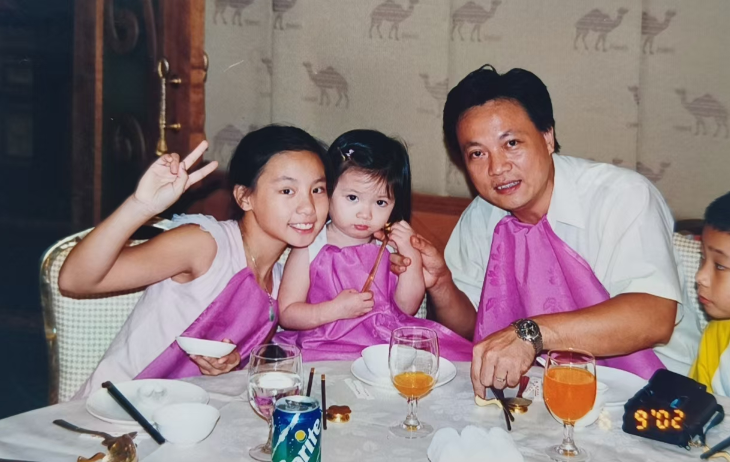
0 - 12 Months


In the first year of my life, most of my language interaction occurred with my primary caregiver- my grandmother and my father. Although I was not yet able to speak, but when I hear about their voice, I will immediately turned my head toward them and tried to make noise for their attention. Even without words, the way that I made sound was my language and I started to participating in communication when I was a baby.
My Grandmother My father
12 -24 Months


My Grandfather
My Aunties
Between twelve to twenty-four months, I began to use single words and gestures intentionally. At this stage, I began to use language as my communication tool. My grandmother sang me lullabies in different languages, they are mostly Mandarin and Cantonese.
However, as my grandfather and my other family members were Fujianese, their Cantonese was not as fluent as my grandmother's. Hokkien was also the main language we used in our home. Therefore, in this period, I learn a significant amount of Hokkien, arguably more than the Cantonese that would later become my dominant first language.
Growing up in this linguistic environment meant that my first language did not follow a clear and singular path. My earliest communication patterns were shaped in a multilingual environment context
24-36 Months


My brother and cousins
In this stage, as I grew older. My exposure to Cantonese increased significantly as my family started to take me out frequently. I started to build social relationships and interacted with the children who were my age. I use Cantonese in my everyday interactions as Cantonese was the standard language in Hong Kong. I started to use language to express my feelings and needs.
In the same year, my younger brother was born. As the youngest child in my family, that was the first time someone younger entered my world. This new identity shaped how I use language. When I tried to communicate with my brother, I tried to use body language like holding his hand and imitating the adults around me. Sometimes, I sang him the lullabies my grandmother once sang to me.
In this stage, I was no longer only the recipient of languagem I started to shape the language for others so I could better communicate with them, like my brother. For example, I adjusted my tone, speaking softly to him. Language became a tool for relationship building in this stage.
The influence of my family on my language
Across my language development from birth to thirty-six months, it is undeniable that my family played an important role in shaping my language development. Vygotsky’s concept of the Zone of Proximal Development (ZPD) suggests that children are able to complete tasks with the support of others (Fellowes & Oakley, 2014). My early language development were scoffold by different family members.
From my earliest months, my primary caregivers consistently communicated with me through speech and tone. When I was not capable of saying words. Their consistent communication provided the basis of my language and guided me to participate in communication.
As I grew older, the way that I developed my language learning is to listening to the different languages spoken by various family members. In this period, I observed and tried to transform these languages into my own means of communication. For me, different languages have different meanings. Hokkien is the language that I can link my family members together, reminding where we came from. Cantonese is my daily language and connects my friends and me. Mandarin to cultural continuity. Language was not only a communication tool but a tool that helped me to build my early sense of belonging.
As I matured further, I began to transform the linguistic knowledge I had received and used it to support others. Especially when I was interacting with my younger brother. I moved from being scaffolded to becoming one of scaffolding, showing that the language developed better when it was involved with lots of social interaction.
The Reggio Emilia notion of the “hundred languages of children” further deepens this reflection. The experience of my early language development had shown that language was not only about vocabulary or grammar, but also included body language, tone, rhythm and social interaction. With this experience, I realise that children are not only capable of using one language, but are also able to learn multiple languages.
Create Your Own Website With Webador